Most actors learn lines the slow way first. They highlight their part, read it over and over, and wait for it to sink in. It feels productive, because the words get more familiar every time. Then they put the script down and the words are gone.
Familiarity isn't memory. Recognizing a line on the page and producing it from nothing are different skills, and only the second one helps you on stage. The fastest methods all share one idea: spend less time looking at the line and more time trying to say it without looking.
One page or twenty, the method is the same. Only the dread scales.
Read for sense before you memorize a word
Read the whole scene once and answer three questions. What does your character want? What's getting in the way? Where does the scene change direction?
This isn't an acting exercise you can skip when you're in a hurry. It's the part that saves you time. Helga Noice, a cognitive psychologist, and Tony Noice, an actor and researcher, spent years studying how professional actors learn scripts, and found that they rarely drill words by rote. They work out why each line is said, and the words stay as a result. A line you understand as a response to something is much easier to retrieve than a string of sounds.
Split the scene into beats
A beat is a stretch of text where your character is pursuing one tactic. When the tactic changes, a new beat starts. Mark those changes in your script and give each one a short name in plain words: flatters him, changes the subject, gives up and tells the truth.
Now you aren't learning two pages. You're learning six small units and the order they come in. If you go blank later, the name of the beat will often get you back on track.
Say it out loud, from the start
Silent reading uses your eyes. Performing uses your voice, your breath and your body, so bring them in right away. Say the line, look away from the page, and say it again. Walk around while you do it. Pick up a mug on one line and put it down on another. Physical actions give the words something to attach to, which is one reason lines often come back more easily once a scene is on its feet.
Test yourself before you feel ready
This is the step everyone skips, because it's the one where you find out. Cover your line, try to say it, then check. You'll get it wrong at first. That's the point.
Memory researchers call this the testing effect. In a well-known 2006 study, Henry Roediger and Jeffrey Karpicke gave students short passages to either reread or recall on paper. Five minutes later, rereading won. A week later it had lost badly: 61% recalled after repeated tests, 40% after repeated study. The rereaders were also the ones who felt sure they'd remember. They were students with prose, not actors with lines, but the trap will sound familiar.
A simple loop for each beat:
- Read the beat out loud twice.
- Cover it and say as much as you can.
- Check, and notice exactly where you went wrong.
- Repeat until you can get through it twice in a row.
- Add the next beat, then run both together.
Keep linking each new beat back to the one before it. The joins are where most mistakes hide.
Use first letters as a bridge
There's a big jump between reading a line and saying it from nothing. First letters fill the gap. Write out only the first letter of each word, and your line becomes something like this:
To be, or not to be: that is the question.
Your brain has to supply the words, but the letters stop you from getting completely stuck. Move to first letters as soon as you can, and take them away sooner than feels comfortable.
Learn your cue along with your line
Knowing your words is only half of it. You also need to know when they start. Learn the last few words of the line before yours as part of your own line, and practice hearing them rather than just reading them. We go deeper on this in our guide to cue-to-cue memorization.
Let sleep do some of the work
Sleep helps your brain hold on to what you practiced, and the same practice spread out beats one long session. An hour split across two days will usually serve you better than that hour crammed into one evening. Run your lines just before bed, then test yourself first thing in the morning. What you can still say is what's stuck. What you've lost is tomorrow's work.
A three-day schedule
If you have a scene to learn by the end of the week, try this:
- Day one, 45 minutes. Read for sense, mark your beats, and work through the loop above for the first half of the scene. Run it once before bed.
- Day two, two 30-minute sessions. Test yourself on yesterday's work first. Learn the second half. Run the whole scene with your lines partly hidden.
- Day three, three short runs. Run the whole scene with your lines fully hidden, at performance speed. Spend the rest of your time only on the lines that tripped you up.
If you only have one night, skip day three and shrink day one. Understand the scene, learn it in beats, and test yourself every few minutes rather than rereading.
Common ways to waste time
- Learning with your eyes only. If you've never said it out loud, you haven't learned it yet.
- Starting from the top every time. You'll end up with a perfect first page and a shaky last one. Start some runs from the middle.
- Mumbling at speed. It feels fast, but you end up memorizing the mumble. Use real pauses and real intentions.
- Practicing without cues. You can know every word and still miss your cue.
Where Ollie fits
This whole process works with a pencil and an index card. It works faster with someone to feed you cues, and that's what we built Ollie to do.
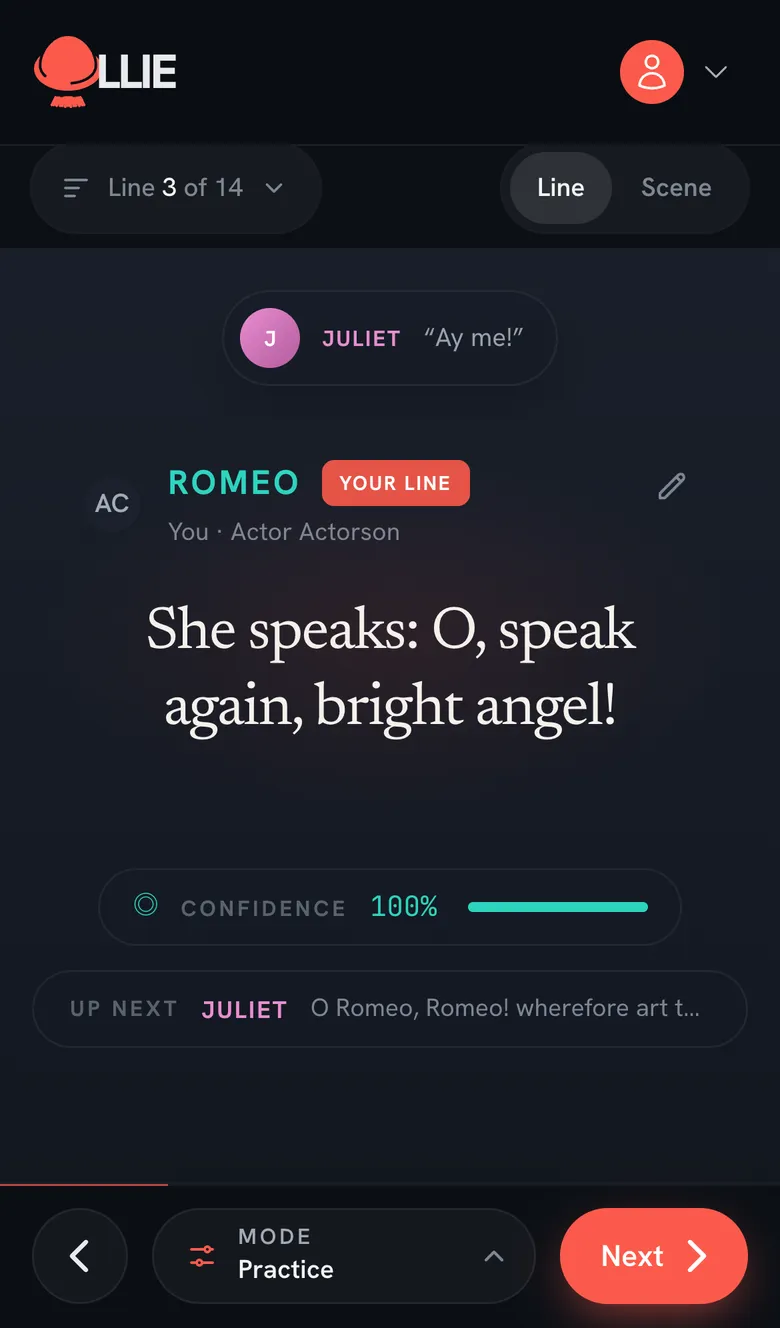
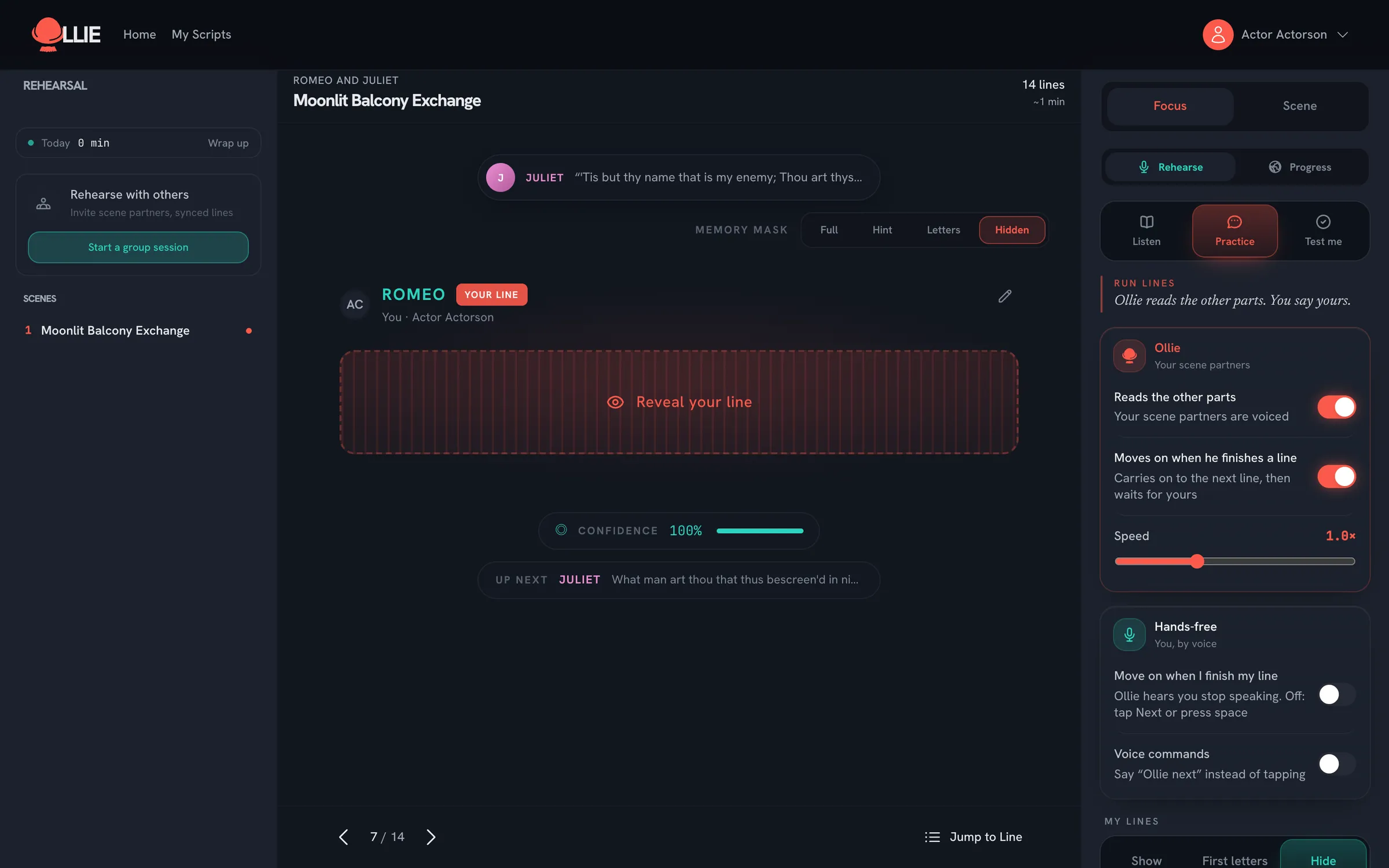
Upload your script as a PDF, Word (.docx) or text file, and Ollie reads the other parts out loud in voices you choose. Listen reads the scene through, your lines too, so you can get to know it. Practice reads the other parts and waits for you to say yours, and you can set your own lines to Show, First letters or Hide as you get more confident. Test me hides your lines and scores each one by how many of its words it heard, so the lines that fall apart are easy to find.
Ollie is in an invite-only beta, but anyone can run a short scene in the demo, no sign-up. If you're taking on more than one scene, read how to learn a whole play next.