Friends make great line partners for about 20 minutes. After that, they read flatly, skip stage directions, and start checking their phones. They also tend to be asleep at the exact hour you remember you have rehearsal tomorrow.
You don't need another person for most of this. Here's what works, and what each method will quietly get wrong.
Cover the page
This is the oldest method and it costs nothing. Hold an index card over the script. Slide it down to reveal the other character's line, read that line, then say your own line with the card in place. Slide the card to check.
Good for: the first stage of memorizing, and any time you're away from your phone.
The catch: you're reading your cues rather than hearing them. Since you can see them coming, it's easy to anticipate, and you'll be practicing a slightly different skill from the one you need on stage. It's also easy to cheat by letting your eye slip down the page.
Record the other parts yourself
Record yourself reading the other characters' lines, leaving a silence after each one that's long enough for your own line. Then play the recording back and speak into the gaps.
Good for: practicing with your hands free, including while you walk, cook or do the dishes. Hearing cues out loud is much closer to real rehearsal.
The catch: making the recording takes time, and it has to be redone when the director cuts a page. The gaps are also fixed. If you rush, you'll be left waiting in silence. If you take a real pause, the next line will talk over you. Listening to your own voice read every part also gets old quickly.
A useful variation is to make a second recording with your own lines read in, so you can listen to the whole scene and absorb its shape before you start speaking in the gaps.
Write it out
Write your lines out by hand from memory, then check them against the script. It's slow, but it shows you exactly what you do and don't know. It's especially good at catching small errors you'd miss when speaking, such as "a" instead of "the," or a dropped word at the end of a sentence.
Good for: getting word-perfect on difficult passages, and any text where the exact wording matters.
The catch: it does nothing for your timing, your cues or your voice. Use it as a spot check rather than your main method.
Use first letters
Reduce your lines to the first letter of each word and read from that. It gives you just enough support to keep you moving, and you can do it on a bus without looking strange. Our guide to memorizing lines fast explains how this fits into a full learning plan.
Good for: the stage between reading a line and knowing it.
The catch: you can come to depend on the letters, so make sure you take them away.
Use an AI line partner
A reading app takes the other parts and speaks them out loud, and the better ones listen for you to finish before they answer. This removes the two main problems with recordings: you don't have to make anything, and the timing follows you instead of the other way around.
Good for: repetition. You can run a scene 30 times, at any hour, and it won't sigh at you.
The catch: a synthetic voice won't surprise you or react to your choices the way a real actor will. It's a tool for learning your lines and building your timing. It isn't a replacement for working a scene with a real partner.
How to keep the scene alive
The risk of running alone is that you rehearse one reading until it sets like concrete. Your director will need a jackhammer. A few habits help prevent that.
- Listen, even when you know what's coming. Treat each cue as something you're hearing for the first time. Let it change what you say next.
- Don't memorize line readings. Vary your delivery on purpose. Run the scene once angry and once amused, or try it in a whisper. You're learning the words, not one way of saying them.
- Get up and move. Sit, stand, walk across the room, and find something to do with your hands. Lines learned in a chair can disappear the moment you're on your feet.
- Run at performance speed sometimes. Fast, low-energy runs are useful for review, but your memory also has to work when you're breathing and feeling the scene.
- Put an object in the empty chair. Having somewhere to direct your lines stops you from saying them to the floor.
A good solo session
Thirty minutes is plenty if you use it well:
- Warm up, five minutes. Listen to the scene through once, or read it aloud, with no pressure to remember anything.
- Work the hard part, ten minutes. Pick your weakest stretch of text. Run only that, with your lines hidden, until you can say it twice cleanly.
- Run the scene, ten minutes. Go from start to finish without stopping. If you go up, take a prompt and carry on, and make a note of where it happened.
- Review, five minutes. Go back to the lines you noted. These become the start of tomorrow's session.
When you do need a person
Some things can't be practiced alone. You need other people for physical business, overlapping dialogue, and the way a line lands differently when someone looks you in the eye. Do your solo work so that the time you spend with your cast can go to the acting. When your castmates are available, spend the time on exactly those things. Our guide to preparing for a table read has more on getting ready to work with a cast.
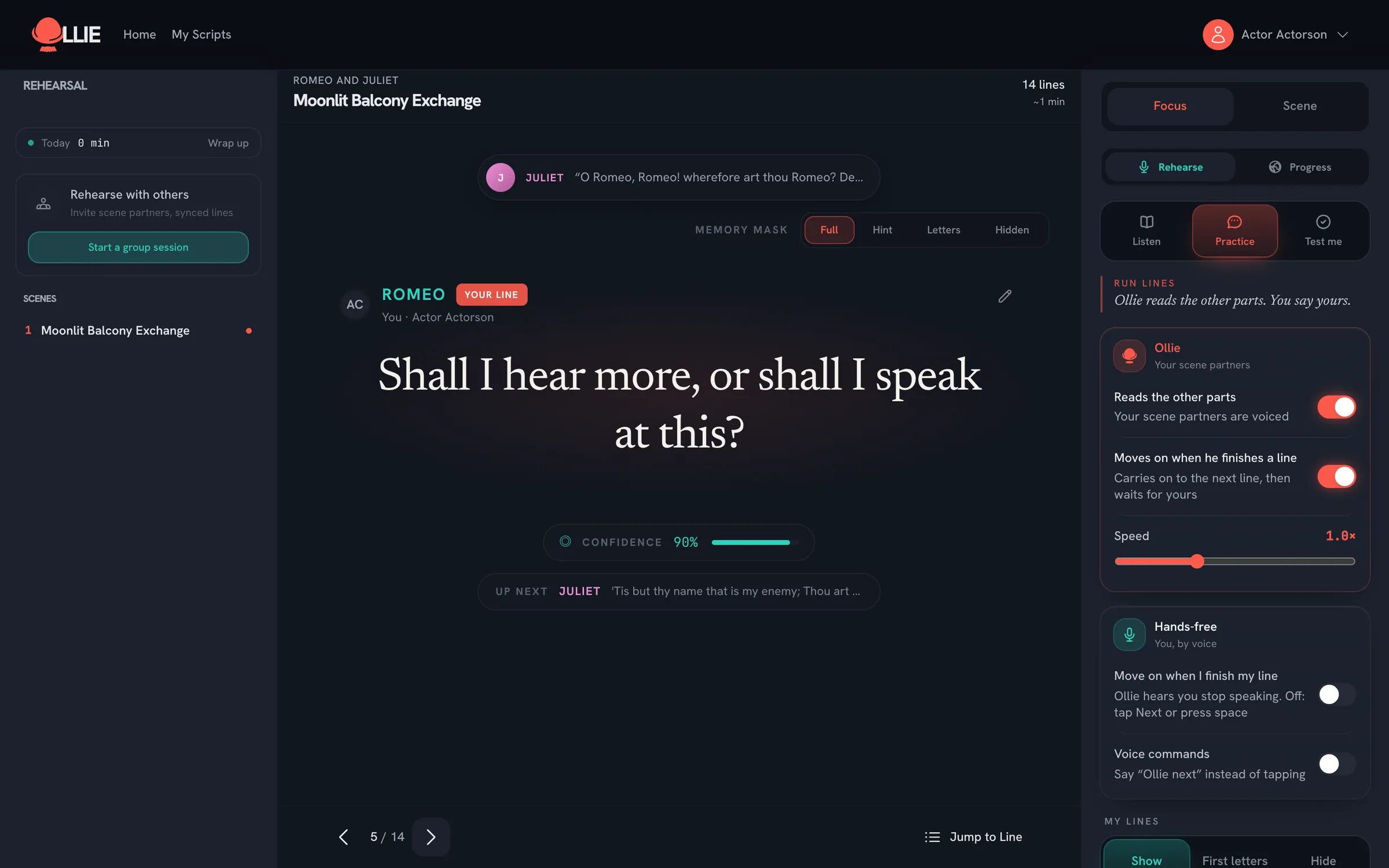
Running lines with Ollie
Ollie is an AI line partner built for this kind of practice. Upload your script, pick your part, and choose a voice for each of the other characters. Ollie reads the other parts out loud, then waits for you to start, however long that takes. Turn on hands-free and it moves on when it hears you stop. If you like a big pause mid-line, tap Next yourself instead. With voice commands on, say "Ollie line" if you're stuck, or "Ollie repeat" to hear something again.
You can adjust how much help you get with your own lines by switching between Show, First letters and Hide. When you want to know where you really stand, Test me hides your lines and scores each one by how many of its words it heard.
Ollie is in an invite-only beta, but the demo is open to anyone: a short scene in your browser, about two minutes, no sign-up.