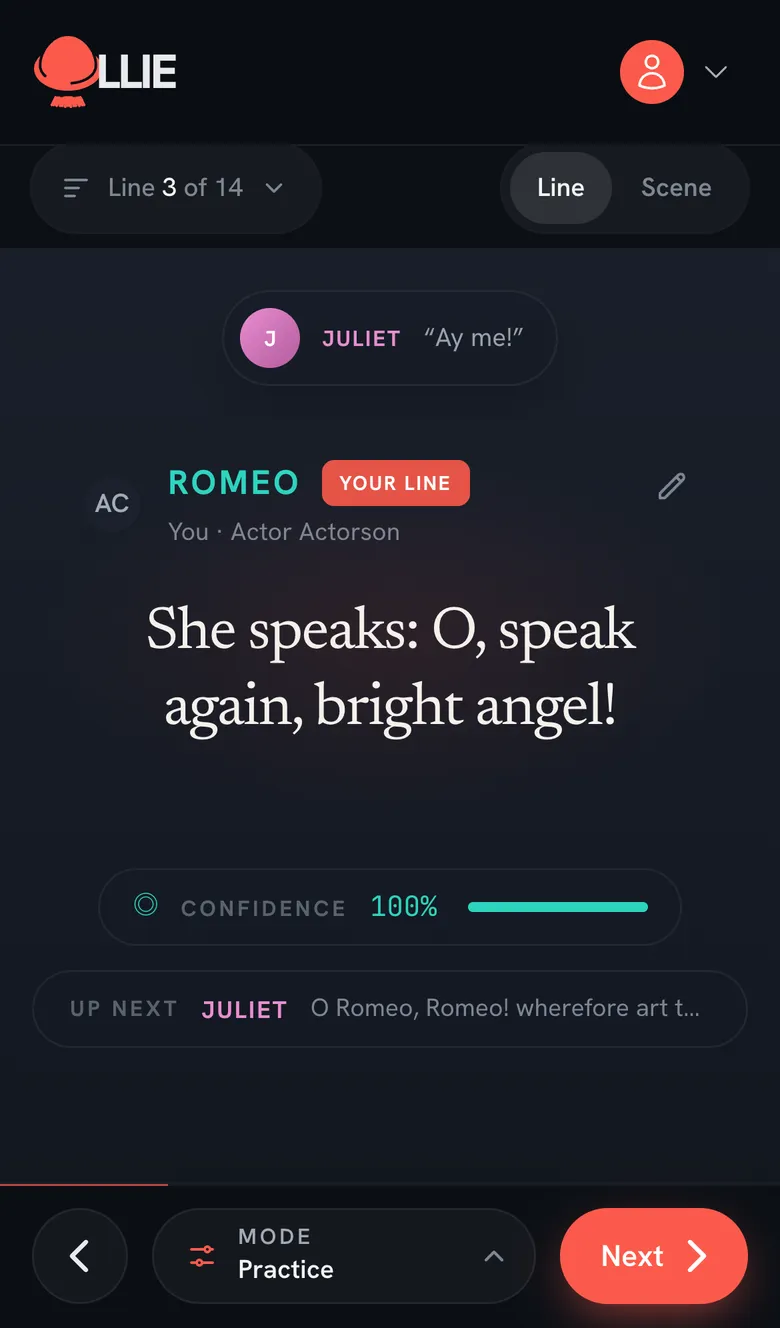
Here's a familiar rehearsal moment. An actor can recite their whole part perfectly in the hallway. Then, in the room, another actor finishes a line and there's a silence. Everyone waits. "Oh, sorry, is that me?"
The actor wasn't missing any words. They were missing the link between someone else's line and their own. Learning that link on purpose is what we mean by cue-to-cue memorization.
(Yes, "cue-to-cue" also means the tech rehearsal where you stand in the dark for hours while someone fixes a light. Different thing. This one you can do in your kitchen: learning your lines as responses to your cues.)
Why isolated lines let you down
If you learn your lines as a list, they're connected to each other. Line one leads to line two, line two leads to line three. On stage, that connection isn't what you need, because line two doesn't follow line one. It follows whatever the other character says in between.
That causes two kinds of trouble. You can miss your cue altogether, or you can jump ahead, because the end of your last line pulls you straight into your next one. When another actor paraphrases or drops a line, an actor who has only learned their own lines has little to hold on to.
Memory works largely through association: one thing brings back another. So you need to build the association you'll actually use, from the other character's words to yours.
What counts as your cue
Shakespeare's actors often got only their own lines, each with a cue of a few words. That was the whole script. You get more than that, and your real cue is bigger too. It has three parts.
- The verbal cue. The final words of the previous line. Learn these exactly.
- The thought cue. What the other character has just said or done that makes you need to reply. This one survives if someone paraphrases.
- The physical cue. Anything else that triggers your line, such as a door closing, a look, or a phone ringing. Many lines are cued by an action, and it's easy to overlook them when you're learning from the page.
Mark all three in your script. Take this exchange from Macbeth:
MACBETH
If we should fail?
LADY MACBETH
We fail! But screw your courage to the sticking-place, and we'll not fail.
If you're playing Lady Macbeth, the verbal cue is "fail." The thought cue is more interesting: your husband is losing his nerve, and you can't allow it. Once you've understood the thought, you're not just waiting for a word. You've got a reason to speak.
Five ways to practice it
1. The cue-only drill
Go through your script reading only the last few words before each of your lines, then say your first few words in response. Don't say your whole line. You're only drilling the handoff. You can get through a surprising amount of a play in ten minutes this way, and it's a great way to review once you know the text.
2. Paraphrase the reason
Before each of your lines, say in your own words why you're about to speak. "He's backing out, so I'm going to shame him." Then say the actual line. This builds the thought cue, and it's the best protection when something goes wrong in performance. If you know why you're speaking, you can often get back on track even if the exact words have gone.
3. Hear it, don't read it
Reading a cue and hearing one aren't the same. When you read, you can see your line coming. When you hear a cue, you have to listen and respond in real time, as you will in performance. Have a partner, a recording or an app speak your cues, and hide your own lines while you practice. Our guide to running lines alone compares the options.
4. Vary the speed
Actors don't always deliver lines at the same pace from one night to the next. Practice with quick cues so that you pick up your line without a gap. Then practice with long pauses, so you don't panic and jump in early. Your line shouldn't depend on a fixed rhythm.
5. Start from the middle
Pick a random cue anywhere in the scene and go from there. If you can only find a line by running up to it from the top, your memory is relying on sequence rather than on cues. Being able to start from any cue is also a very practical skill, because directors will often say "let's pick it up from..." with no warning.
Handling long speeches and short exchanges
Different kinds of text need different handling.
Rapid back-and-forth is where cue practice matters most. With a page of short lines, it's easy to lose track of which response goes where, especially if several cues sound alike. Drill them in pairs until each cue triggers only its own reply.
Long speeches have internal cues. Each thought in a monologue sets off the next one, so treat the end of each thought as a cue for the next. Our guide to memorizing Shakespeare has more detail on working through long verse speeches this way.
Repeated cues are a particular hazard. If another character says "I don't know" three times in a scene, that cue could send you to any of three different places. Mark these and find what's different about each, such as what's happened just before it or how far the argument has come.
How to tell if it's working
Three signs show you're making progress:
- You pick up your cues without a noticeable gap, at any speed.
- You can start from any cue in the scene.
- When another actor changes a word, you can still respond naturally.
That last one is the prize. You stop waiting for your turn and start listening.
Practicing cues with Ollie
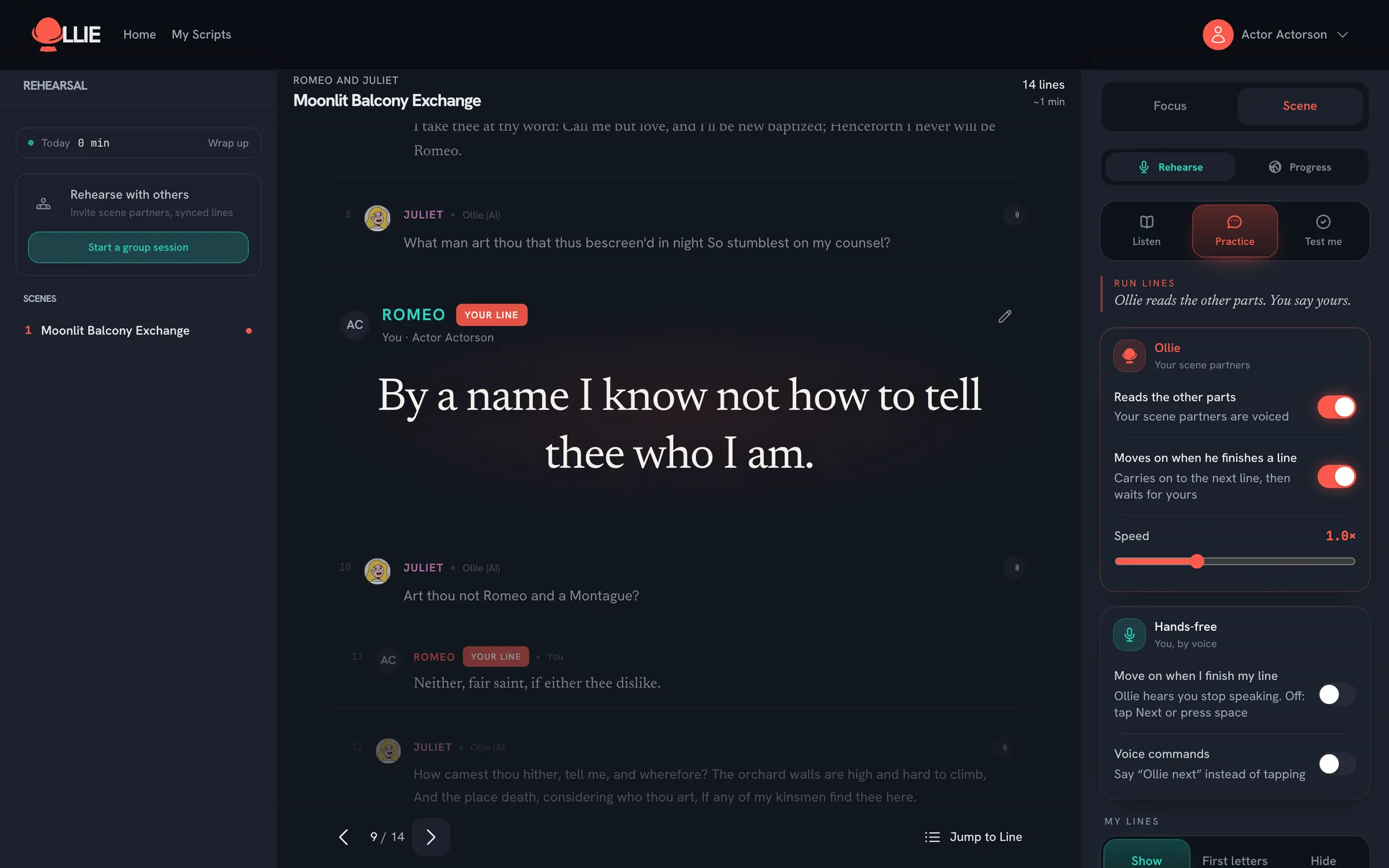
Cue practice is what Ollie is built around. Upload your script and pick your part, and Ollie speaks the other characters' lines out loud, so you hear each cue rather than reading it. Then it waits, and you say your line.
In Practice, you can set your own lines to Show, First letters or Hide, so you can start with support and gradually remove it. With hands-free on, Ollie moves on when you finish and your hands stay free, so you can walk the scene as you go. Stuck? Say "Ollie line" and carry on. Test me then hides your lines and scores the words in each one, so you can see which lines still need work. Whether you came in on time is for you to judge.
Ollie is in an invite-only beta, and anyone can try the demo: a short scene, about two minutes, no sign-up.