Shakespeare looks like the hardest thing you'll ever learn. The sentences are long, some of the words are unfamiliar, and you can't get away with a near miss when half the audience knows how "To be, or not to be" goes.
But Shakespeare gives you something most modern writers don't: a built-in memory aid. Verse has a rhythm, and once your ear knows that rhythm, a wrong word or a missing syllable can feel wrong before you've even worked out why. Here's how to use that.
Understand every word first
You can't learn what you don't understand, or at least you can't learn it well. Before you memorize anything, go through your part and look up each word or phrase you can't confidently explain. A good annotated edition will cover most of them. Watch out for words that look familiar but have changed their meaning or dropped out of use. When Juliet asks "wherefore art thou Romeo?" she's asking why he's Romeo, not where he is.
Then paraphrase your speech, line by line, in plain modern English. Write it out if it helps. It's a useful test: if you can't paraphrase a line, you don't know what you're saying yet, and neither will the audience.
Find the thoughts, not just the lines
Shakespeare's sentences often run across several lines of verse, and a printed line break isn't necessarily where a thought ends. Go through your text and mark each period, colon and semicolon. Punctuation varies by edition, since editors added much of it, so treat these as a first guess at the thought units and trust the sense. Those units are what you're going to learn.
Pay attention to how each thought leads to the next. Shakespeare's characters tend to work things out as they speak, and each new thought grows out of the last. Take these lines from Macbeth:
Tomorrow and tomorrow and tomorrow
Creeps in this petty pace from day to day
To the last syllable of recorded time,
The speaker starts with a word, repeats it, then describes how time crawls on, then how far it goes. If you follow that train of thought, each line sets up the next one. You're no longer trying to memorize an arbitrary order.
Get the meter into your body
Most of Shakespeare's verse is iambic pentameter: ten syllables per line, alternating unstressed and stressed, like a heartbeat. da-DUM, da-DUM, da-DUM, da-DUM, da-DUM.
But, soft! what light through yonder window breaks?
Try these exercises:
- Tap it. Say the line and tap your hand on your chest or leg on each stressed syllable.
- Walk it. Take a step on each stress, and turn at the end of each line. Doing it this way helps connect the words to your body and to your breath.
- Overdo it. Say a line with an exaggerated, sing-song beat. It'll sound silly, and you won't do it in performance, but it's great for learning the pattern.
Once the rhythm is in place, it starts to catch your mistakes. Drop a syllable and the line will limp, and you'll feel it. The rhythm won't save you from every swap, though. "And" for "but" scans just fine, which is why those little words need checking against the text.
Don't be alarmed by lines that break the pattern. That "tomorrow" line has eleven syllables. Shakespeare varied the meter all the time, and those variations are often worth noticing. A line with an extra syllable, or a stress in an unexpected place, can show you where a character is off balance. It's also a detail that can help you remember the line, since it stands out from its neighbors.
Use the sounds
Shakespeare left you cheat codes. Use them.
- Rhyme. Couplets often close a scene or a speech, and they're a gift. They tell you exactly where you're going.
- Alliteration and repeated sounds. In "From forth the fatal loins of these two foes," or "Full fathom five thy father lies," the repeated sounds help tie words together.
- Lists and contrasts. Shakespeare loves pairs of opposites and lists that build. Work out what's being contrasted, and you'll remember the order.
- Repeated words. When a word comes back, ask why. It's usually doing something, and it can serve as a signpost through the speech.
Build long speeches backward
For long speeches, try learning the last thought first, then the second to last, and so on, each time running through to the end. This has one big benefit: each time you run it, you're heading into text you already know well, so your confidence grows toward the end of the speech instead of fading out.
However you build it, work one thought at a time. Say it out loud, cover it, and test yourself right away. Connect it to the previous thought before moving on. There's more on this method in our guide to memorizing lines fast.
Use first letters for the exact wording
Close enough isn't good enough with Shakespeare. Writing out first letters is a particularly good fit here, since it forces you to produce the exact word while still giving you some support. Those lines from Macbeth become:
Tomorrow and tomorrow and tomorrow
Creeps in this petty pace from day to day
Many verse speeches have small words like "and," "but," "yet" and "for," which are very easy to swap. These words matter, because they show how one thought connects to the next. Check them carefully against the text.
Don't let the rhythm take over
Once you've learned your verse, watch out for the opposite problem: a steady, chanted delivery that thumps along with every beat. The meter is there to support the sense, not to replace it. To shake off the chant, try these once you're secure:
- Paraphrase the speech out loud, then go straight back into the real text.
- Speak it to a real person, trying to change their mind.
- Run it as if each thought has only just occurred to you.
Keep the small lift at the end of each verse line, so that the thought carries into the next line, but let the sentence decide where the stresses land.
Hearing it helps
Shakespeare was written to be heard. Listening to your scenes over and over gets the rhythm and the sense into your ear, especially at the start, when the language still feels foreign. Be careful about copying performances you admire, though. It's better to hear the scene read in a fairly plain way than to absorb another actor's choices.
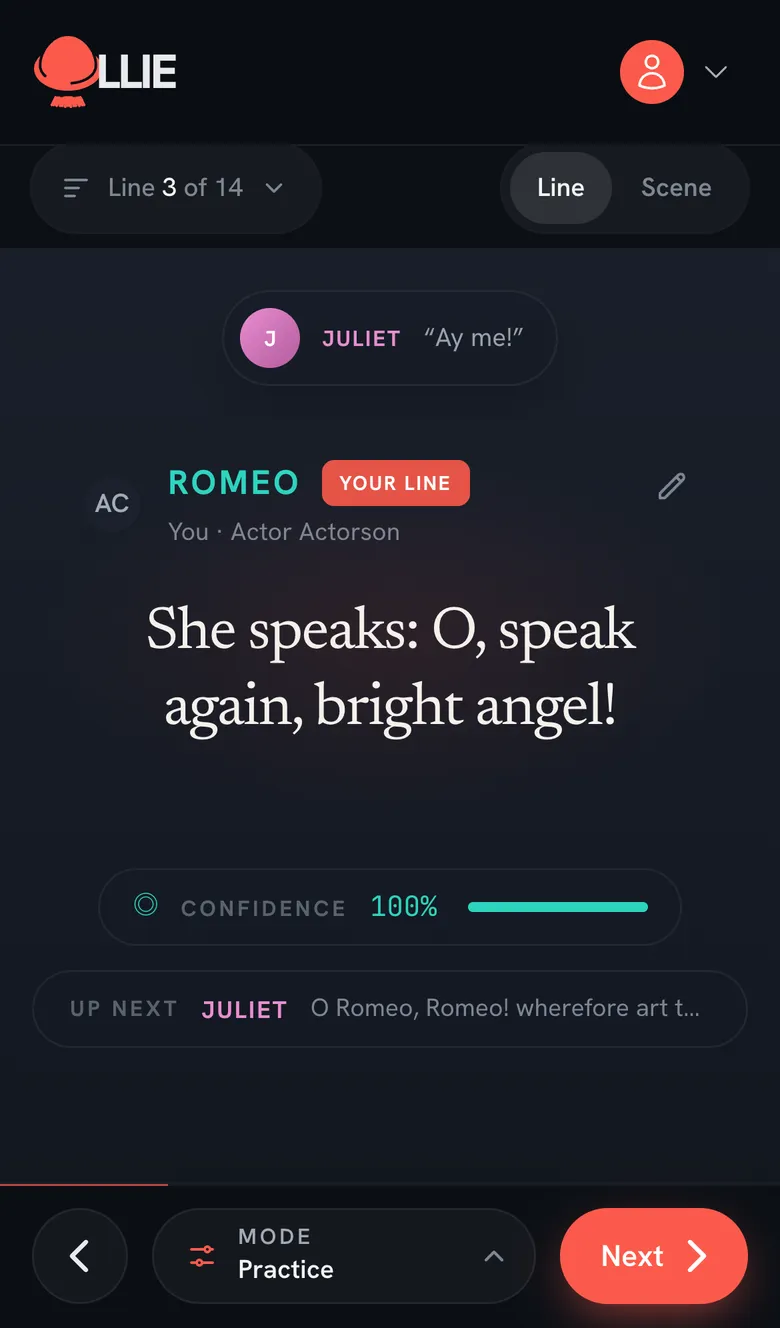
Learning Shakespeare with Ollie
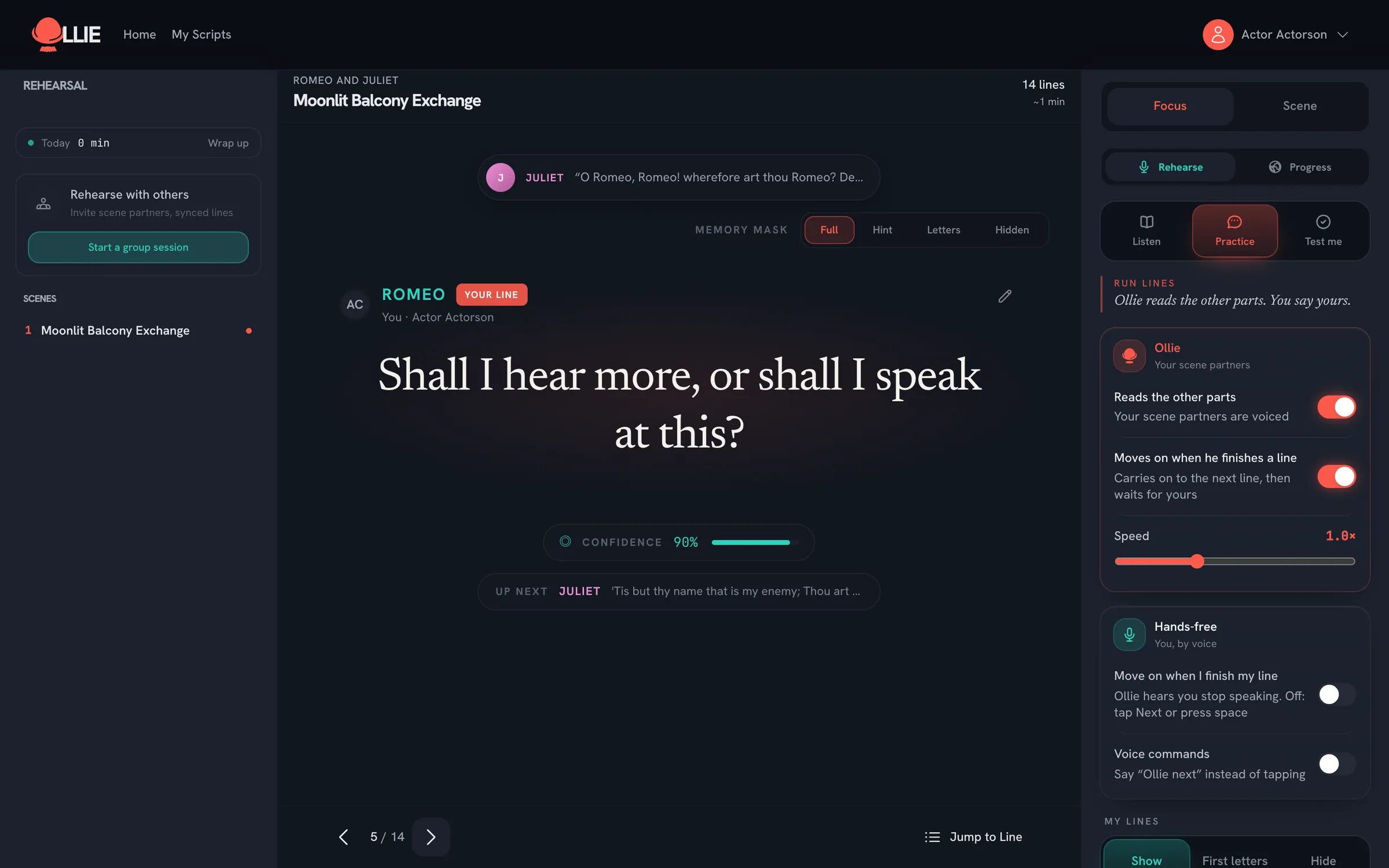
Ollie works well with verse. Use Listen to hear your scene read through in the voices you've cast, which is a low-effort way to get the language into your ear before you've started learning it.
In Practice, Ollie reads the other characters and waits for you. Set your own lines to First letters when you're ready for the exact-wording stage, then move to Hide. When you think you've got a speech, Test me hides your lines and scores what you say against the script. That's a useful check on missing words, but it's a score for the line, not a line note, and it can't tell when words come out in the wrong order. For the exact wording of a verse speech, keep a pencil and a friend with the text.
If you're working on a full role, not just a speech, see how to learn a whole play. Ollie is in an invite-only beta, but anyone can try the demo, no sign-up.