The first read-through can feel like a test. You're sitting across from the director and the people you'll spend the next few weeks with, reading out loud, and it's easy to feel you're being judged.
Remember what it's for. Nobody at that table has heard this cast say this play out loud yet. It gives the director and writer a sense of how the script sounds, and it starts to form your cast into a group. You're not auditioning. You got the job. Nobody expects a finished performance. They do expect you to know what's going on and be ready to take part. Here's how to get there.
Read the whole play first
Read the play, all of it, before you show up. It sounds obvious, but actors do sometimes read only their own scenes, and it shows. Then read it again, this time paying closer attention to your character.
As you go, write down:
- What your character wants, overall and in each scene.
- What other characters say about your character, which can tell you a lot.
- Any words, names or references you don't recognize.
- Any questions for the director.
Look up every pronunciation
This is the cheapest way to look prepared. Nobody remembers a good pronunciation. Everyone remembers the actor who said "Hermy-own." Look up every unfamiliar word, name and place in your part. If the play has a dialect or an accent, ask ahead of time whether you should use it at the read. Don't assume.
Read your part out loud
Silent reading won't prepare you to speak. Read your scenes out loud at least a few times, because long sentences, unusual phrasing and places you'll need to breathe only reveal themselves when you say them. Those are also the places you might otherwise stumble at the table.
Do it with the other parts too, if you can. Your goal is to understand the rhythm of the conversation, how fast the exchanges move, and where your lines come in. You don't need to have your lines learned, but you should know your way around.
Make choices, but stay flexible
Come in with a point of view. If you've thought about what your character wants, your read will have some life in it, and you'll give your director something to respond to. Reading flatly because you're afraid of being wrong won't help anybody.
But treat those choices as a first draft. You'll hear things from other actors that you hadn't imagined, and the most useful thing you can do is respond to them. If your scene partner plays a line in a way that changes everything, let it change what you do.
Mark up your script
You'll be looking at your script a lot, so make it easy to read.
- Highlight your lines so you can find them quickly, but keep your cues easy to see as well.
- Number your pages, if they aren't already.
- Mark your entrances and exits, and any place where you're off stage for a long stretch.
- Bring a pencil. Things will get cut and changed, and you'll want to be able to erase them later.
If you're given a revised script, go through it carefully. Reading from an old version is a common and avoidable problem.
On the day
- Bring water and show up early. You'll be talking and sitting for hours, and the good chair goes fast.
- Follow along constantly, including scenes you aren't in. Lose your place and everyone waits while you find it. It always happens on your big line.
- Look up when you can. You don't need to perform, but try to connect with the people you're speaking to.
- Listen and react. Laugh if it's funny. A read where people respond to each other is far more useful than one where everyone's staring at their own highlighter marks.
- Don't apologize for mistakes. If you stumble, just go back and fix it, or keep going.
- Take notes, but do it quietly. Don't try to rewrite your performance while you're in the middle of it.
Reading stage directions
Often a stage manager or an assistant reads the stage directions. If you're asked to do it, read them clearly and at a steady pace, and don't perform them. Keeping them brisk helps everyone keep track of what's happening without slowing down the scene.
Afterward
The read tells you a lot, so write down what you noticed while it's fresh. Which scenes felt alive? Where did you get lost? Did you hear anything that changed how you think about your character? And what did the director say?
It also gives you your starting point for learning your lines, so don't leave it too long. Now that you've heard the play, this is a great moment to get started. Our guide to learning a whole play explains how to plan your weeks, starting with a map of your part.
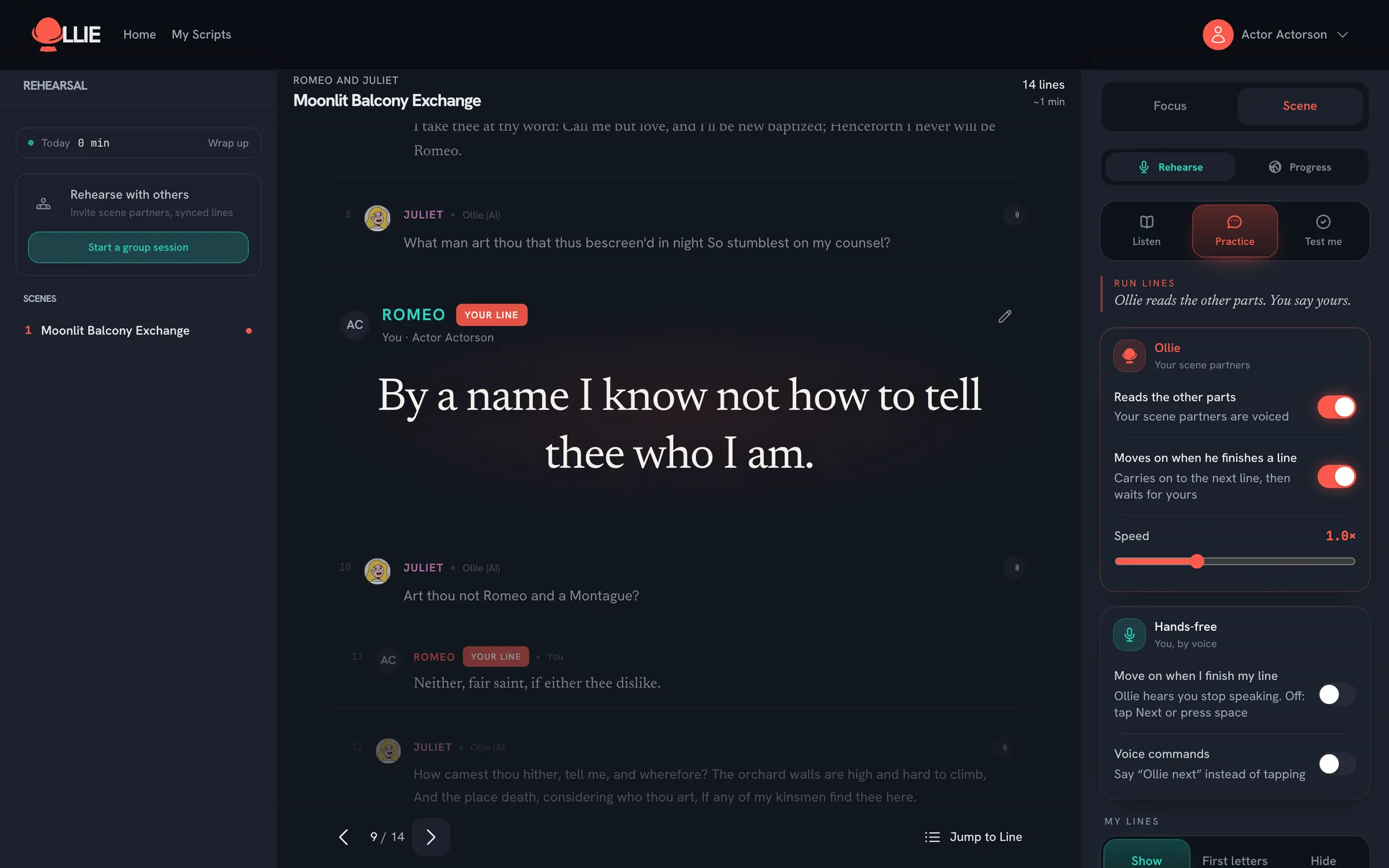
Getting ready with Ollie
Ollie can help you get ready, especially if you can't get your cast together early. Upload your script and cast a voice for each character.
Listen reads the entire scene aloud, your lines included, so you can hear how it moves before the day. Play it while you cook, then go back to any scene that lost you.
Practice reads every other part and leaves your lines to you, so you can get used to speaking them at conversational speed with someone answering. Leave your lines on Show for this. You're not memorizing anything yet, just getting comfortable. For more ways to do this alone, see our guide to practicing without a partner.
You can also rehearse together before the real thing. Start a group session and castmates can join from their own devices, wherever they are, while Ollie reads any part nobody's covering. So if the third person in your scene can't make it, you still have a full scene.
Ollie is in an invite-only beta. To get a feel for it, run a short scene in the demo, no sign-up.