In most musical rehearsal processes, music comes first and choreography comes next. The book scenes, meaning the spoken dialogue between songs, tend to get whatever time is left. Songs also get learned almost by accident, since melody does so much of the work. Dialogue doesn't come with a tune, so it's easy to reach the last week of rehearsals knowing every harmony and still calling for lines.
Nobody buys a ticket for the dialogue between numbers. They will, however, notice when you forget it. With a bit of planning, it doesn't have to be the weakest part of your show.
Treat the book as part of the score
A good musical doesn't stop for its songs. A character reaches a point where speaking isn't enough, so they sing, and when the song ends, something has changed. If you learn your scenes as separate islands between numbers, you'll lose that thread.
So read the whole show in order, including the lyrics. Then go through your part and ask two questions about every song you're in or near. What's happened in the scene that makes this song necessary? And what's different once it's over? Knowing the answers will make your dialogue easier to remember, because every scene will have somewhere it needs to get to.
Map your part around the songs
Make a list of your scenes in show order, and mark where each one meets a song. For each, write down:
- The line that takes you into the song.
- The first thing you say after it.
- Anything happening physically, such as a costume change or a move into place.
The lines on either side of a number do a lot of work, and they're the easiest ones to neglect. Those transitions come with extra pressure, too, because you might be out of breath, or moving, or waiting to hear a note.
Start early, in small amounts
After four hours of "five, six, seven, eight," nobody goes home eager to learn a page of dialogue. So keep your sessions short. Fifteen minutes a day from the first week of rehearsals is much easier than trying to learn the entire book in the last few days.
Use the beat-by-beat method for each scene: understand it, break it into beats, say it aloud, and test yourself before you feel ready.
Learn your cue lines and your music cues
A musical adds cues that a straight play doesn't have. Besides the other characters' lines, you may need to learn:
- Dialogue cues into music. The band or orchestra may start on a specific word, so the conductor is relying on you to say it clearly and on time. Learn these with extra care, and don't paraphrase them.
- Song cues into dialogue. If you speak right after a number, your cue is the end of the music or the last sung word. If there's applause, you may need to hold for a moment before you go on. Practice from the last lyric straight into your line.
- Vamps. Sometimes the band repeats a short passage until you reach a certain line. The music will wait for you, but only if you get to the right word.
Cue practice is especially helpful for these moments. Our guide to cue-to-cue memorization has some drills you can adapt.
Practice with underscoring in mind
Underscoring is music played under spoken dialogue, and it can catch you off guard. You may have learned a passage at your own pace, then find on the first day with the band that it has to line up with the music. A line might need to land on a particular chord, or finish before a sung entrance.
Ask your music director for any underscored passages early on, and for a rehearsal recording if one is available. Run your lines along with it. It's much better to find out now that you need to take a breath earlier, or pick up the pace, than to find out at the sitzprobe.
Don't lock yourself into a fixed rhythm for the rest of the book, though. Conductors and scene partners vary from night to night, so make sure you know your text well enough to be flexible.
Separate your song work from your scene work
Melody carries lyrics in a way nothing carries dialogue, so they need different practice.
- Use your music tracks for lyrics and notes. Speaking through your lyrics in rhythm is also a great check.
- Use spoken run-throughs for the book. Don't rely on the songs to carry you through the show, and do practice scenes on their own.
- Then put it together. Once you have both, run from the top of a scene through the song and into the next scene, because that's the path you'll take on stage.
Be careful about a common trap. Songs are often easier to remember, so a tired brain will spend all its practice time on the fun stuff. If you know your numbers, close the music app and work on your book.
Run scenes with choreography in your body
Book scenes often begin or end in the middle of staging. If you exit a scene into a big dance break, your memory of the scene is tied to where you're standing and which way you're facing. Once you have your blocking, walk it as you run your lines at home. Even marking it in your living room will help, and it builds links between your movement and your words.
Be especially careful of breath. Words are harder to get out when you're gasping. If you have a speech right after a big number, rehearse it that way: jumping jacks or a flight of stairs, then the lines. It's a little silly, and you'll find out fast where you need to breathe.
Using Ollie for book scenes
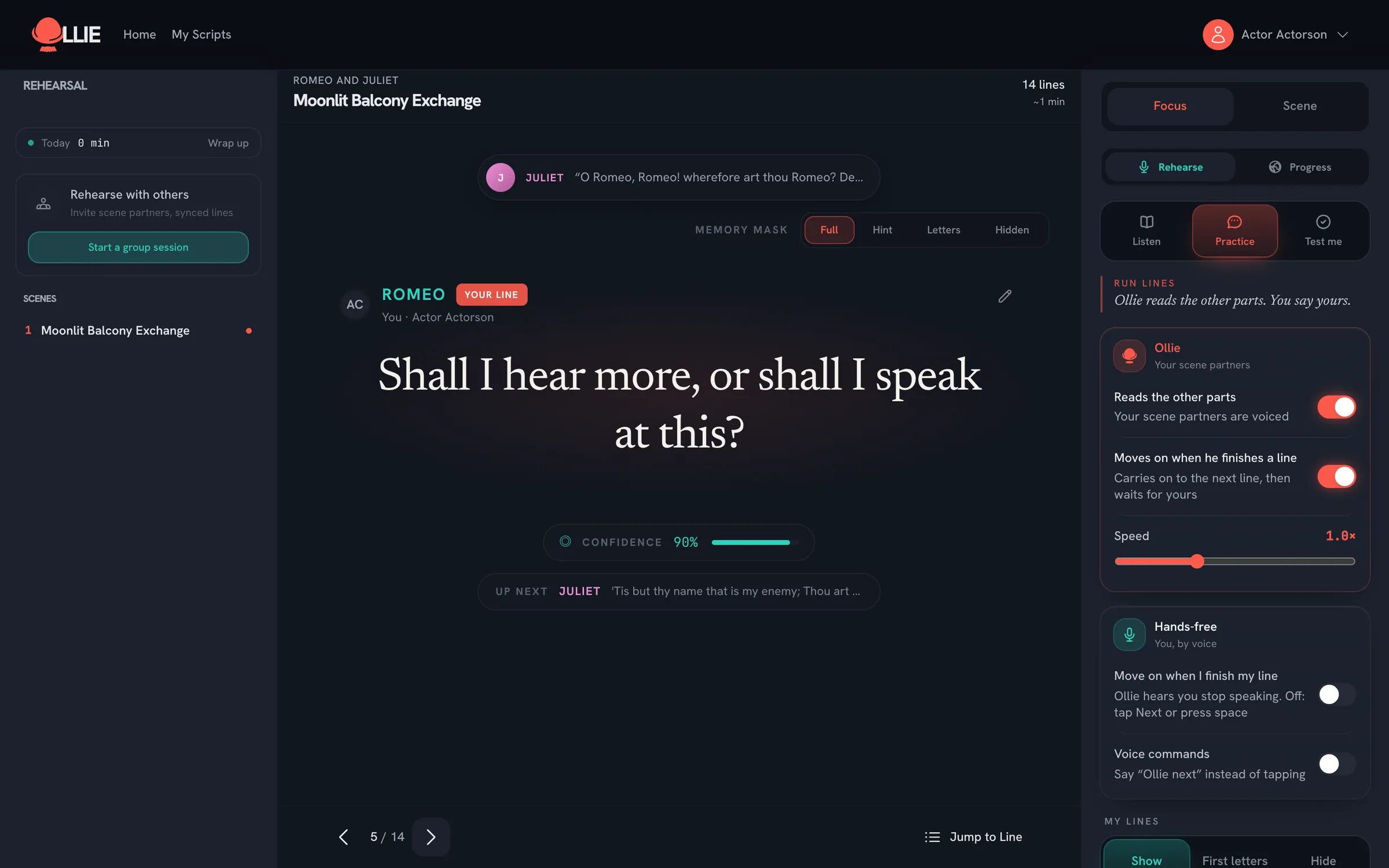
Ollie is for the dialogue part of your show. Upload the script, choose the scenes you want to work on, and cast the voices for the other parts. Ollie reads the text but doesn't sing or play music, so it won't replace your vocal tracks or your music director. If lyrics are in your script, Ollie will speak them as plain text, which still helps with the lead-in and the way out of a number.
Use Practice to run your dialogue, switching your own lines between Show, First letters and Hide. With hands-free on, Ollie moves on when you finish speaking and takes voice commands like "Ollie next," so you can walk your blocking with your phone on a table nearby. Test me then scores each line you say with it hidden, so you can see which scenes need your next 15 minutes.
Castmates can join a group session from their own devices, too, which is handy when rehearsal hours are short.
Ollie is in an invite-only beta, and anyone can try a short scene in the demo, no sign-up. Then read about getting word-perfect before tech week, which matters even more when you're also adding a band.