There's a long way between "I know my lines" and "I know my lines." The first means you can get through a scene and the sense is right. The second means every word is what the playwright wrote, and it stays that way when the lights change, your costume doesn't fit and someone's prop goes missing.
Tech week is a bad time to close that gap. The focus shifts to lights, sound and scene changes, and there's little room for you to work on text. You'll also be tired and distracted. Anything shaky will get shakier. So aim to be word-perfect before it starts, and use the two weeks beforehand to get there.
Why "close enough" isn't
Paraphrasing can seem harmless, but small changes do cause real problems.
- Your castmates rely on your cues. If you change your last few words, the actor waiting for them may hesitate or jump in late.
- Your cues set off technical cues. Lights and sound can be called on a specific word. In a musical, so can the band.
- Playwrights choose their words. A rhythm or a joke can be lost when one word changes. Licensed shows usually require it, too.
- Errors grow. A small mistake you've repeated 50 times becomes the version your memory trusts.
Two weeks out: audit your lines
First, find out how bad it is. It's worse than you think. Everyone's is.
Ask your stage manager or a friend to follow along in the script during a run and mark every mistake. Many stage managers give line notes, which are written notes showing what you said against what's in the script. Take these seriously. They aren't criticism. They're the most useful thing anyone can give you at this stage.
You can also do this on your own by recording yourself and checking it against the script. It's slow but revealing. Most actors are surprised by how many small changes they make without knowing it.
Sort what you find into groups, because each type of error needs a different fix:
- Swaps: you say "but" instead of "and," or "the" instead of "a."
- Drops: you miss a word or a phrase, often at the end of a line.
- Rewrites: you've unconsciously improved on the playwright's sentence.
- Jumps: you skip ahead or go to a similar passage in another scene.
- Blanks: you simply go up on a line.
Fix each kind of error
For swaps and drops, look at why the correct word is there. Often it's a clue to the character's thought. Then write the sentence out by hand, and say the correct version out loud ten times, slowly at first, then at speed. Stress the troublesome word to start with, and then let it go back to normal.
For rewrites, your brain has decided your version makes more sense. Work out what the writer's version does that yours doesn't. Once you've got a reason for the original phrasing, it tends to stick.
For jumps, find the two similar passages and compare them directly. Identify the exact point where they split, and practice going from that point in each direction. There's more on this in our guide to learning a whole play.
For blanks, look at the line before. A blank is often a cue problem rather than a line problem, so the link is what needs work. Our cue-to-cue drills can help you here.
A two-week plan
Days 14 to 10: find and fix. Get your line notes, sort your errors, and fix them one by one. Spend most of your time on your weakest scenes, and don't practice the ones you've got solid just because they're fun.
Days 9 to 6: test under pressure. Do a few things that make your lines harder to say, which will show you what's secure.
- Start from any point in the scene.
- Do something demanding with your hands while you run it, such as folding laundry or making a sandwich.
- Run a "speed-through," saying everything as fast as you can while still being accurate.
- Have someone interrupt you, then pick up where you left off.
Days 5 to 1: run it all, and rest. Do full runs of your part in order, including your transitions between scenes. Keep practicing the lines that still come up in your notes, but stop adding pressure. Sleep matters a lot now. A tired brain makes more errors, and sleep helps new learning stick.
What to do during tech
You won't be able to run lines much during tech week, but you can still protect what you've built.
- Take a few minutes each day. A quick run on your own, even at low speed, keeps things fresh.
- Run the words. Some casts do a quick Italian run, speaking the whole play at top speed with no acting. If yours doesn't, ask a few castmates to do one with you.
- Review your errors list. Look at the few spots that were difficult. Don't try to learn anything new.
- Stop running lines in the wings. You've done the work, and the person next to you is trying to find their prop. Things will go wrong on stage, and that's fine. If you've got a good understanding of your character's thoughts, you'll find your way back.
If you do go up in performance, don't panic. Stay in character, listen to your scene partner and think about what your character wants. It's often enough to get you back on track, and often the audience doesn't notice.
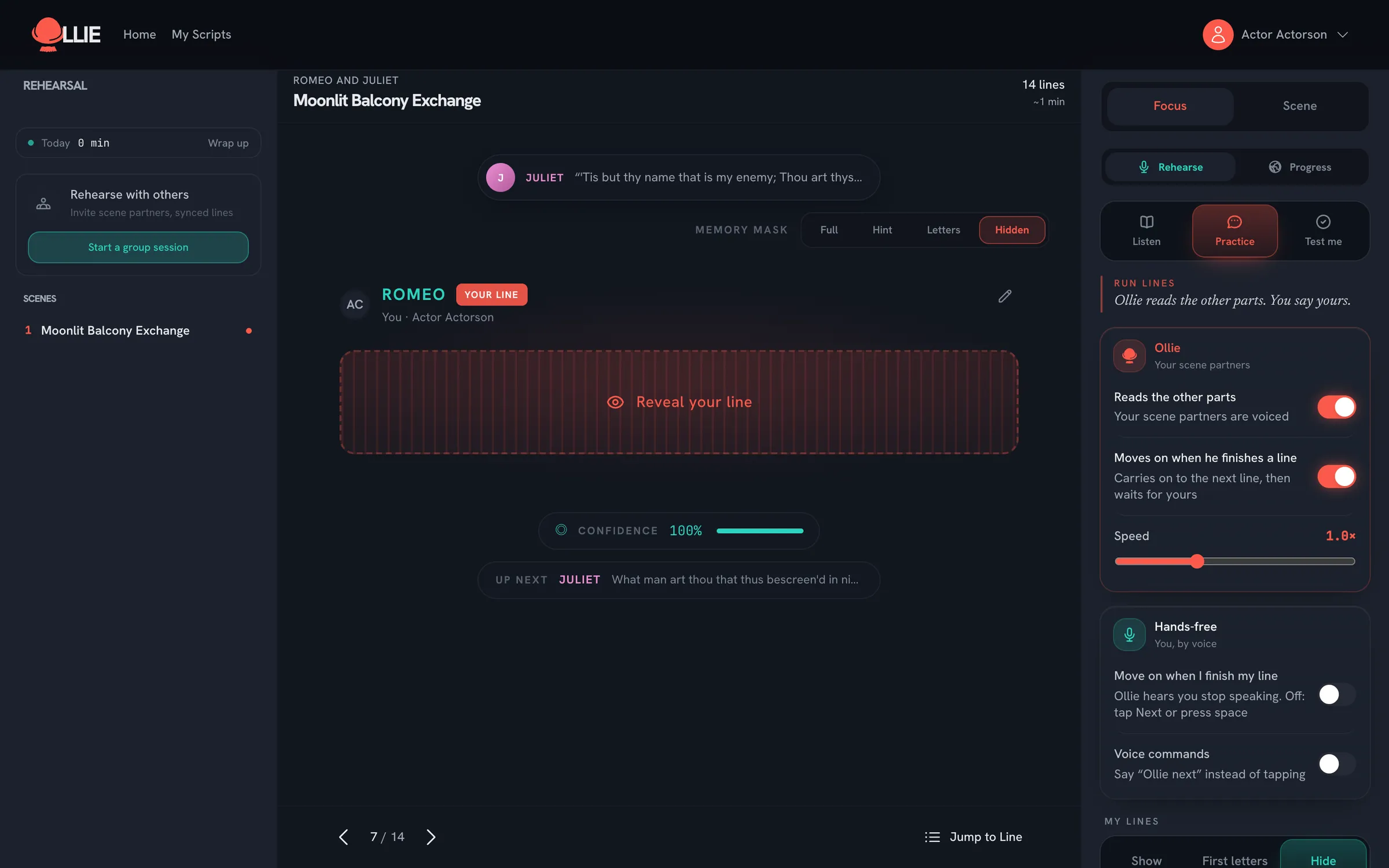
Finding your weak lines with Ollie
Test me won't replace a stage manager's line notes. Ollie hides your lines, listens to you say them, and counts how many of the script's words it heard, so it spots lines that fall apart, not a swapped "and" or words in the wrong order. Over repeated runs you get a record for each line, so instead of a general sense that Act Two is shaky, you can see which lines keep coming up short. Use your line notes for the fine print.
Then go to Practice for those lines and set your own lines to First letters, then Hide. Say "Ollie line" if you need a prompt, or "Ollie repeat" to hear something again. When your castmates are around, they can join a group session from their own devices, and Ollie will cover any part that's missing.
Ollie is in an invite-only beta, but the demo lets anyone run a short scene and then test themselves, no sign-up. If you're still at an earlier stage, start with memorizing lines fast.